As a parent, your child’s health, happiness, and future are of the utmost importance to you. We want our children to have not only an aesthetically beautiful but also a healthy oral and dental structure. This is where Pediatric Orthodontics, meaning orthodontic treatments that begin at an early stage, comes into play. Many parents view orthodontic treatment merely as a way to straighten crooked teeth. However, that is only one part of the treatment. Pediatric orthodontics is a functional and preventive field of medicine that shapes your child’s future oral and overall health.

What is Pediatric Orthodontics?
Pediatric orthodontics is the specialized branch that diagnoses, prevents, and treats irregularities in the teeth, jaw, and facial structures of children and adolescents. Childhood is a critical period for dental and jaw development. Early treatment is crucial and helps prevent future dental problems your child might face. The goal of the treatment is not just to align the teeth, but also to guide the growth and development of the jaw correctly, ensuring that the facial and oral structures work in harmony as a whole. It plays a significant role in the proper eruption of teeth, the correction of jaw discrepancies, and the correct functioning of chewing. Pediatric Orthodontics is about building the architecture of your child’s smile on the most solid foundations.
What are the Benefits of Early Treatments in Pediatric Orthodontics for Healthy Dental Development?
The benefits of orthodontic treatment directly affect your child’s quality of life. Properly aligned teeth and a harmonious jaw structure ensure the smooth operation of the body’s most fundamental functions. What are these?
Malocclusions (improper bites) can lead to insufficient breakdown of food and digestive problems, whereas orthodontic treatment corrects these functions. When teeth close together correctly, it allows for the ideal grinding of food, ensuring effective chewing and healthy digestion.
Dental and jaw disorders can restrict the movements of the tongue and lips, preventing the correct pronunciation of certain sounds (e.g., a lisp). Orthodontic treatment helps your child’s speech skills develop by removing these obstacles. It ensures they speak clearly and intelligibly.
A narrow upper jaw structure can constrict the nasal airway, preventing healthy nasal breathing. This condition often forces the child to breathe through their mouth. Mouth breathing, in turn, can trigger a range of problems, from poor sleep quality to upper respiratory tract infections.
Jaw expansion treatments not only create space for teeth but also widen the airway, allowing your child to breathe more healthily. Early interventions (such as jaw expansion) create the necessary space for permanent teeth to erupt properly. This significantly reduces the likelihood of needing to extract healthy teeth in later years to relieve crowding. More importantly, skeletal jaw problems that can be corrected during the growth phase may require complex and costly jaw surgeries in adulthood. Early intervention prevents such future tooth extractions and surgical procedures for your child.
Crooked teeth create numerous hiding spots for food debris and bacteria. This increases plaque buildup, raising the risk of tooth decay and gum disease. Straight, well-aligned teeth are easier to brush and floss than crooked teeth. Orthodontic treatment makes teeth easier to clean and helps prevent cavities. A child who is hesitant to smile due to crooked teeth or noticeable jaw problems may withdraw in social settings. A healthy and aesthetic smile boosts a child’s self-confidence.
When Should Pediatric Orthodontic Treatment Begin?
One of the most critical factors in the success of orthodontic treatment is proper timing. The question “When should we start?” is one of the most common concerns for parents. The ideal time for your child’s first orthodontic examination is no later than age 7. This is a universal standard accepted by leading professional organizations worldwide, such as the Turkish Orthodontic Society and the American Association of Orthodontists. A check-up at age 7 does not mean your child will get braces immediately. The main purpose of this visit is to diagnose any existing issues early, foresee potential problems, and create a roadmap to determine the best time for treatment. This age corresponds to the mixed dentition period, where both baby (primary) and permanent teeth are present in the mouth. Early intervention helps to identify potential problems in the child’s teeth or jaw in advance, and treatment during this period is much easier. It can reduce the likelihood of needing more complicated and costly treatment in the future.
What are the Early Warning Signs for Pediatric Orthodontic Treatment?
Some small details in your child’s dental and jaw structure can be precursors to larger orthodontic problems that may arise later. The most careful observers in this process are undoubtedly the parents. Therefore, if you observe any of the early warning signs listed below, you do not need to wait until your child turns 7 to consult an orthodontist. Early diagnosis often means simpler, shorter, and more effective treatment processes.
● Observable Signs Related to Teeth and Jaw Structure
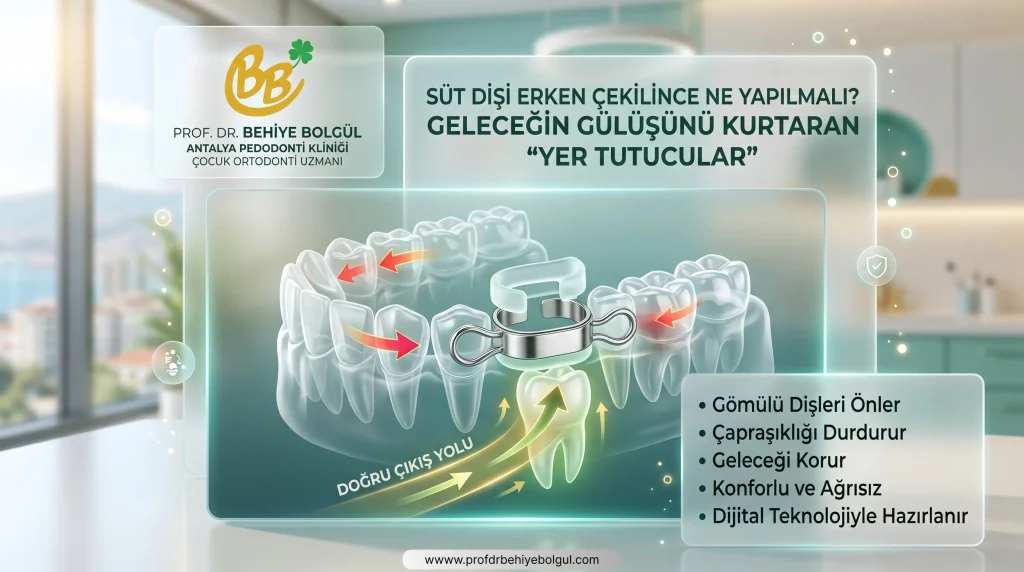
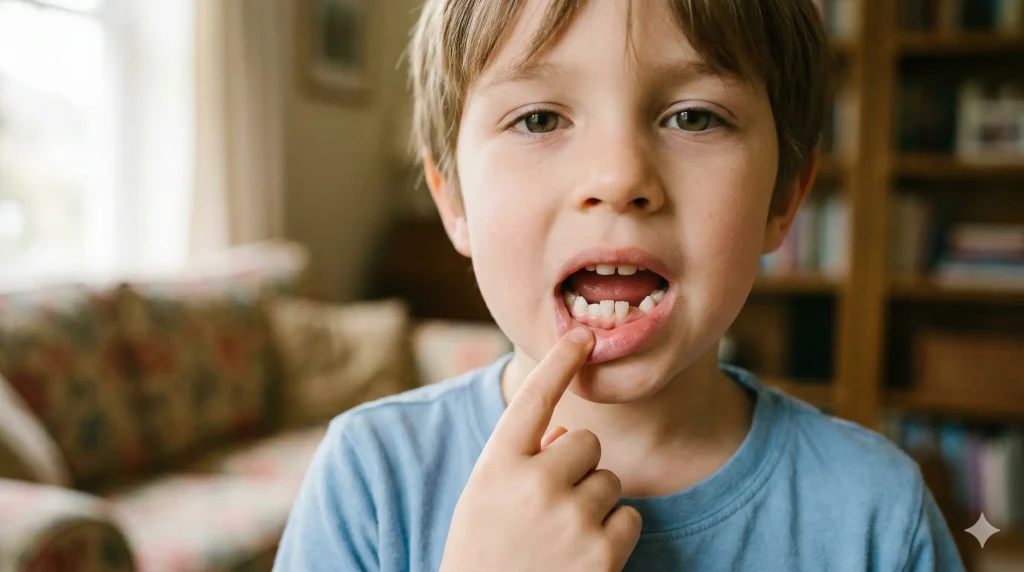
The most obvious signs of an orthodontic problem are related to the teeth and jaw. The premature or, conversely, very late loss of baby teeth can prevent the permanent teeth underneath from erupting in the correct position. Similarly, crooked, overlapping, or teeth erupting in the wrong place are situations that require consultation with a specialist. Sometimes, even if the teeth appear to be straight, there can be problems with the bite. If your child has difficulty chewing or biting, or avoids certain foods, it could be an indicator of an abnormal bite. Additionally, a “clicking” sound from the jaw when opening or closing the mouth, or the jaw shifting to one side, may indicate a problem with the jaw joint. Imbalances in the facial structure are also an important clue. An upper or lower jaw that appears disproportionately forward or backward relative to the rest of the face, and a noticeable asymmetry between the right and left sides of the face, may indicate the presence of an underlying skeletal problem.
● Pay Attention to Habits and Functional Problems
Sometimes, orthodontic problems can stem from certain unconscious habits or functional disorders in your child. Habits such as thumb sucking, pacifier use, or lip biting, especially if they continue after the age of 4-5, can negatively affect the structure of the teeth and jawbone. They can lead to permanent problems like an open bite in the front teeth. Furthermore, if your child consistently breathes through their mouth while sleeping or awake, it is often a sign of a narrow upper jaw or an underlying respiratory problem. The way they swallow is also very important. Normally, the tongue should touch the palate during swallowing. If the tongue is constantly pushed between or against the teeth (tongue thrust), it can cause gaps to form, especially between the front teeth.
What are the Common Orthodontic Problems in Children?
The most common orthodontic problems encountered in children include crowded teeth, jaw problems, tooth displacement, and bite disorders. Different treatment methods can be applied for each problem.
The Most Common Problem: Crowded Teeth and Lack of Space
Perhaps the most frequently observed orthodontic issue in children is crowded teeth, which occurs when the teeth cannot fit properly in the jaw. When the jawbone is too small for the total width of the teeth (lack of space), it causes teeth to rotate, overlap, or erupt in a different position than they should. The main causes of this condition include genetic factors, premature loss of baby teeth, or habits like thumb sucking. Crooked teeth are difficult to clean, which paves the way for cavities and gum disease. For treatment, especially at an early age, palatal expanders can be used to widen the upper jaw, creating sufficient space for the teeth. In later years, braces (brackets) or today’s popular alternative, clear aligners, are used to move the teeth into their ideal positions, achieving both an aesthetic and functional arrangement.
Jaw Discrepancies (Class II and Class III Malocclusions)
Orthodontic problems are not always just about the teeth; sometimes the issue lies in the relationship between the jaws.
• Class II Malocclusion: Commonly known as an “overbite,” this condition is where the upper jaw or upper teeth are positioned further forward than the lower jaw. It is visible when looking at the face from the side.
• Class III Malocclusion: This is an “underbite” or “reverse bite” condition where the lower jaw or lower teeth are positioned in front of the upper jaw.
For such skeletal problems, timing and early intervention are of vital importance. Removable functional appliances (jaw-guiding devices) or a face mask are used to correct the jaw position.
Bite Disorders
The harmony between the teeth and jaws is essential for a healthy chewing function. Bite disorders, which are common in children, disrupt this harmony and lead to various problems:
• Deep Bite: This occurs when the upper front teeth cover the lower front teeth much more than normal. This condition can cause wear on the lower teeth and even irritation of the upper palate tissue.
• Open Bite: This is when a vertical gap remains between the front teeth while the back teeth are in contact. It is often caused by long-term habits like thumb sucking or tongue thrusting between the teeth. It can lead to speech impediments.
• Crossbite: Normally, the upper teeth should fit outside the lower teeth. A crossbite occurs when the opposite is true for one or more teeth, meaning the lower teeth are positioned outside the upper teeth. This can cause the jaw to shift to one side and lead to asymmetrical facial development.
The treatment for these types of bite disorders is planned based on the cause. Appliances, braces, or clear aligners are used to achieve the correct bite.
Tooth Displacement and Other Anomalies
Positional irregularities of the teeth, or tooth displacement in general, is another one of the most common orthodontic problems in childhood, both aesthetically and functionally. If the jawbone is too narrow for the teeth, they cannot form a straight line and will overlap, rotate, or emerge outside the proper arch, creating what we call crowding (lack of space). This situation makes cleaning the teeth difficult, increasing the risk of cavities. Conversely, if the jawbone is too wide for the teeth, unwanted gaps (spacing) will form between them. Sometimes, more complex anomalies can occur, such as a tooth being located in a completely wrong position or becoming trapped within the jawbone (impacted). This is where orthodontic treatment steps in, moving each tooth to its ideal position to create not only an aesthetic smile but also a solid foundation for a healthy and balanced chewing function.
What are the Methods Used in Pediatric Orthodontic Treatment?
In our clinic located in Antalya, under the expertise of Prof. Dr. Behiye Bolgül, we provide services with the most modern and effective treatment methods planned individually, taking into account each child’s specific needs. The main methods we use in pediatric orthodontic treatment are:
The Importance of Early-Phase Orthodontic Treatment
The ages of 6-7 in children are when baby teeth begin to be replaced by permanent teeth and jaw growth is most active. With a simple examination at this age, many complex problems that could arise in the future (such as a narrow jaw, skeletal discrepancies, or crowding that would require extractions later) can be resolved easily and quickly. Early treatment is both less demanding and its results are much more stable.
Jaw Expansion Appliances
To ensure teeth can be properly aligned, it is first necessary to provide them with enough space. In cases where the upper jaw is narrow, expansion appliances are used to gently widen the palate, both creating space for permanent teeth and contributing to a healthier airway. When there is a mismatch between the upper and lower jaws, jaw appliances come into play. These appliances, in conjunction with growth and development, guide the relationship between the jaws to the ideal position.
Braces (Brackets)
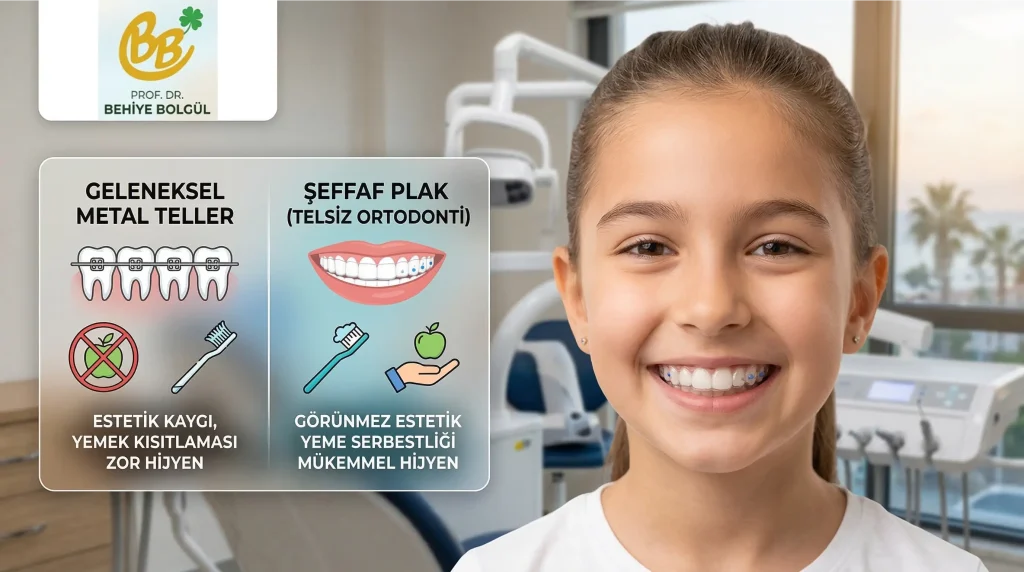
Once the jaw structure has been brought to an ideal state, traditional metal brackets, ceramic brackets, or clear aligners can be used to properly align the teeth and ensure jaw harmony. This treatment ensures that the teeth are gradually aligned and settled into their correct positions over time.
Clear Aligners
They are very difficult to notice from the outside, which allows the child to confidently continue their social life during treatment. They can be easily removed and reinserted when eating or brushing teeth. This makes maintaining oral hygiene much more practical. With a series of aligners produced specifically for the child’s dental structure using three-dimensional technology, the teeth are moved step-by-step to the targeted position.
In conclusion, modern pediatric orthodontics offers a rich variety of solutions that can meet the unique structure and needs of every child. It’s crucial to understand that pediatric orthodontics is not just an aesthetic intervention, but rather a treatment method that directly affects a child’s lifelong essential functions such as chewing, speaking, and proper breathing, as well as their oral hygiene and, most importantly, their self-confidence. The key here is not so much ‘which treatment’ will be applied, but rather the correct determination of ‘why and when’ it should be started. If you would like to get more information about pediatric orthodontics or meet our clinic and our expert team, we invite you to schedule an appointment. Come, let’s confidently build the future of your child’s healthy smile together.