Comfort and Scientific Facts
Quick Summary
In pediatric dentistry, the primary source of trauma and phobia is not the treatment itself, but the traditional local anesthesia (syringe/needle) stage before the procedure. Known medically as C-CLAD (Computer-Controlled Local Anesthesia Delivery), and popularly as “Digital Anesthesia,” it is a technology where the anesthetic fluid is delivered not by the dentist’s finger pressure, but in microprocessor-controlled drop-by-drop speeds calculated by a computer. In our clinic, this system prevents tissue pressure (tearing) pain, numbs only the specific tooth being treated (STA), and prevents children from injuring their numbed lips by biting them after the procedure.
“Mom, are they going to give me a needle?” This question is the most anxious and most frequently heard sentence echoing in the waiting room of a pediatric dentist clinic. A bad injection (needle) experience during childhood can turn into “Dentist Phobia” (Dentophobia) that will last throughout the individual’s life and threaten their future oral health.
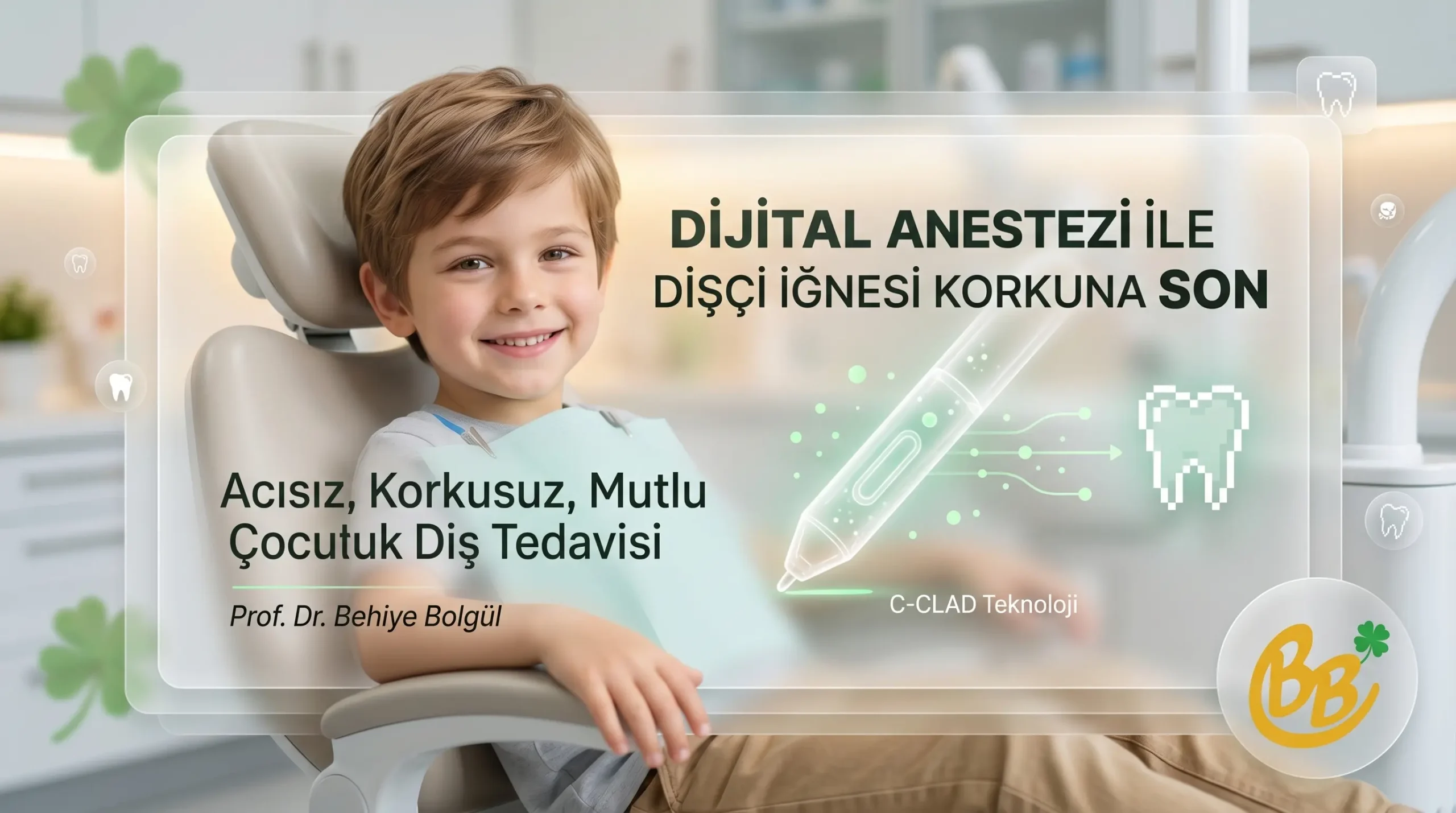
What if we told you that those scary metal syringes have now left their place to digital pens in pediatric dentistry? Digital Anesthesia, a perfect combination of medicine and bioengineering, completely changes the pain and fear equation in children’s dental treatments.
In modern pedodontics, our goal is not just to treat cavities, but to transform the time the child spends in the chair into a trauma-free, pleasant, and highly trusted experience. Unlike traditional methods, digital anesthesia is a revolutionary innovation designed specifically to eliminate this psychological barrier.
Related Articles
- Baby Tooth Treatments
- Sedation and General Anesthesia
- Tongue and Lip Tie Treatments
- Dental Veneers for Children
The Anatomy of Pain: Why is Digital Anesthesia Painless?
The real cause of the sudden and sharp pain felt in traditional local anesthesia is not the needle entering the tissue, but the uncontrolled volume expansion and tissue tearing sensation created by the dentist’s thumb pressure while injecting the anesthetic solution.
Computer-controlled digital anesthesia devices (e.g., The Wand or STA Systems), on the other hand, resemble a magic fountain pen instead of a scary metal syringe. The microprocessor inside (Dynamic Pressure Sensing) instantly measures the density of the child’s gum and periodontal tissue every millisecond using sensors integrated into the tip. Through computer automation, it injects the medication at the slowest and optimum pressure (almost drop by drop) that the tissue will physiologically accept, staying below the pain threshold. Because there is no sudden fluid pressure buildup and “swelling” sensation accumulated in the tissue, the child’s nervous system cannot perceive this process as “pain” or “ache.”
Is “Needle-Free Anesthesia” a Myth? (STA Technology)
Although it is frequently marketed as “Needle-Free Anesthesia” among the public, this system has a microscopic tip at the end that delivers the medicine to the tissue. However, this tip is much more delicate than traditional syringe needles.
The real revolution of the system in pedodontics is its ability to perform Single Tooth Anesthesia (STA). The device reaches the periodontal ligaments around the tooth very precisely and numbs only the tooth with decay.
3 Critical Advantages of Digital Anesthesia in Pedodontics
Unlike traditional methods, the clinical benefits of this technology for children are not limited to the moment of the procedure:
- Visual Camouflage (Psychological Comfort): The device does not look like a traditional and scary metal syringe. Thanks to its ergonomic pen design, the process can be completely gamified by telling children, “Now we’re going to use our magic pen to give a drop to put the decay bugs to sleep.” The brain’s fear center (amygdala) is not triggered.
- Prevention of Lip and Cheek Biting Trauma: After traditional anesthesia, the child’s entire half jaw, cheek, and lip remain numb for hours. Children cannot make sense of this “swelling and numbness” feeling and chew their lips by biting them. Huge bleeding sores (ulceration) occur on the lip hours after the procedure. Since digital anesthesia only numbs the relevant tooth, there is no numbness in the lip and tongue, and the child can immediately return to school and eat after the procedure.
- Prevention of Tissue Damage (Ischemia): Since the medication is given very slowly and according to tissue resistance, the risks of postoperative sensitivity, bruising, or pain in the injection area are minimized.
- Instant Effect and Elimination of Waiting Time: When digital anesthesia is applied (especially with the STA technique), numbness occurs instantly. Unlike other methods, there is no need to wait 10-15 minutes in the chair for the medication to take effect; the dentist can start treatment immediately, which shortens the time the child spends in the chair.
Clinical Comparison: Traditional Method vs. Digital Technology
| Clinical Parameter | Traditional (Classic) Metal Syringe | C-CLAD (Computerized Digital Anesthesia) |
|---|---|---|
| Pain Mechanism | Sudden stretching and tearing pain in the tissue due to manual pressure. | Pressure is computer-controlled; fluid seeps and spreads into the tissue, painless. |
| Visual Phobia Trigger | Large, metal shines, creates an immediate avoidance reflex in the child. | Thin, modern like a pen; the child doesn’t notice what it is. |
| Numbness Area | Wide, uncomfortable numbness covering the entire cheek, lip, and tongue. | Numbness only for the specific tooth being treated (STA). |
| Post-Treatment Complication | High Risk: The child injuring their numb lip/cheek by biting. | Zero Risk: Lip/tongue not numbed, no biting trauma occurs. |
| Dentist Ergonomics | Depends on the dentist’s finger strength and manual sensation. | Computer confirms correct tissue depth with audible and visual alerts. |
Frequently Asked Questions (FAQ)
Can digital anesthesia be applied to all age groups and treatments?
Yes. It can be safely applied to all age groups, from young children with their first primary teeth to adolescents undergoing orthodontic treatment, and for all restorative procedures including root canal treatment. It is the gold standard, especially for children who do not require Sedation and General Anesthesia but have mild anxiety.
Does it prolong the procedure time?
Because the delivery time of the medication to the tissue is slowed down by the computer, it takes about 1-2 minutes longer than a traditional needle. However, since the child does not feel pain during the injection, they remain calm and the subsequent treatment phase is completed much faster in cooperation (compliance).
Is the medication delivered to the body different from traditional anesthesia?
No, the medically used anesthetic medication (solution) is exactly the same. No foreign or different chemical enters the body. The only thing that changes is the “delivery biomechanics” and technology of that medication to the tissue.
Will my child feel nothing at all during the procedure?
The “sharp sting” and “swelling pain” caused by traditional needles are definitely not felt. While the medication is delivered drop by drop, the child may only notice a tiny vibration or a slight feeling of pressure in that area, but does not perceive this as pain.
Is the application of digital anesthesia more expensive than traditional anesthesia?
Although the single-use sterile micro-sets used for digital anesthesia are costly materials, the value they provide in helping the child overcome their fear of the dentist and have a trauma-free treatment is priceless. In our clinic, we offer this technology as a standard approach in many procedures to keep children’s comfort at the highest level.
Fearless, Trauma-Free, and Happy Smiles!
The dentist’s chair doesn’t have to be a tunnel of fear for your child. Meet the superior comfort provided by technology and the modern pedodontic approach integrated with child psychology by Prof. Dr. Behiye Bolgül.