An Invisible Obstacle to Your Baby’s Development: Tongue and Lip Tie
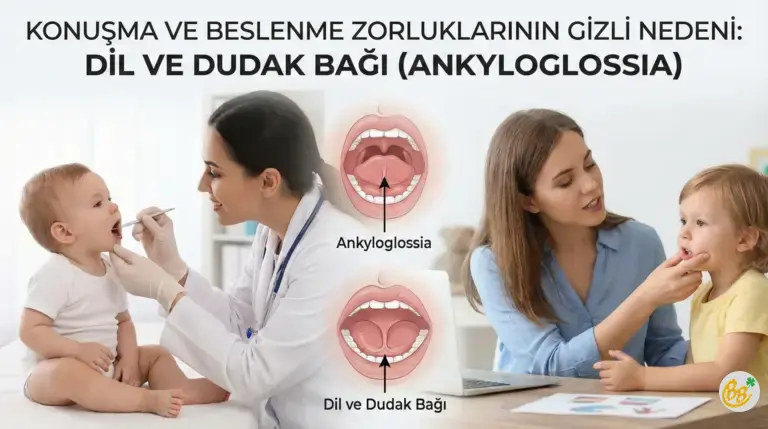
The fussiness your baby experiences during feeding or the hesitations in your child’s speech development might point to a structural issue more common than you think. Known in medical literature as Ankyloglossia and commonly referred to as “Tongue Tie,” this condition is not just a simple extra tissue, but an anatomical anomaly that restricts a child’s oral motor functions.
In this comprehensive guide prepared under the guidance of Prof. Dr. Behiye Bolgül, we will examine tongue and lip ties that trigger many problems from breastfeeding issues to speech disorders, and share details of Frenectomy treatment offered with modern laser technology.
Related Articles
- Tongue and Lip Tie Treatments
- Baby Tooth Treatments
- Pediatric Orthodontics
- Digital Anesthesia in Pediatric Dental Treatments
1. An Anatomical Look: What is Tongue and Lip Tie?
In every individual, there is a soft connective tissue called a “frenulum” under the tongue and inside the upper lip that supports the tissue. However, in some children, this tissue is shorter, thicker, or tighter than it should be.
- Tongue Tie (Lingual Frenulum): It causes the tongue to remain attached to the floor of the mouth, restricting its mobility.
- Lip Tie (Labial Frenulum): This is when the upper lip is attached too close to the gums. This situation can lead to gaps between the front teeth (Diastema) and make tooth brushing difficult.
2. Clinical Symptoms: How to Notice the Problem?
Tongue and lip tie manifest with different symptoms according to age groups. Early diagnosis is critical to avoid negatively affecting development.
| Age Group | Common Symptoms | Impact on Mother / Risks |
|---|---|---|
| Infants (0-2 Years) | Ineffective sucking, letting go of the nipple, gas pains (aerophagia), slow weight gain | Nipple pain, cracks, mastitis formation |
| Children (2+ Years) | Articulation disorders (difficulty with R, L, S, Z, T sounds), “V” or heart-shaped tongue tip | Lisping, loss of self-confidence, mechanical difficulties (licking ice cream, etc.) |
| Orthodontic Effects | Gap between upper front teeth (diastema), gum recession | Risk of crowding, aesthetic concerns |
For more information: Teething Guide for Children
3. Intervention Criteria: When Should It Be Treated?
Not every tongue or lip tie requires surgical intervention. The decision is based on “functional limitation.”
Intervention is necessary if the connective tissue leads to the following:
- Prevents the baby’s feeding and growth,
- Impairs the child’s speech development (clarity),
- Causes gum recession or crowding in the teeth.
Our detailed guide: Baby Tooth Treatments
4. Farewell to Traditional Methods: Laser Frenectomy
Today, in Pediatric Dentistry clinics, traditional methods requiring scalpels and sutures have been replaced by Diode Laser Technology. The release procedure performed with laser (Frenectomy) opens the tissue by vaporizing it instead of cutting it.
- Minimally Invasive: It only affects the relevant tissue, without damaging surrounding tissues.
- Bleeding Control: The laser seals the blood vessel ends during the procedure, so there is almost no bleeding.
- Suture-Free Healing: No stitches are required, which ensures high post-operative comfort.
- Sterilization: The laser beam disinfects the area where it is applied, minimizing the risk of infection.
Comfort and Technology Comparison
| Feature | Traditional Surgery (Scalpel) | Laser-Assisted Frenectomy |
|---|---|---|
| Anesthesia Need | High (Usually injection) | Low (Spray or small amount of local) |
| Procedure Time | 15-20 minutes | 1-2 minutes (Takes seconds) |
| Bleeding Status | Present | None or Minimal |
| Sutures | Usually Required | Not Required |
| Healing Process | 7-14 Days | 24-48 Hours |
| Infection Risk | Variable | Laser provides sterilization |
About our technology: Digital Anesthesia
Expert Opinion
“Tongue and lip tie are not just physical issues, but conditions that affect a child’s social life and development. Waiting for this problem, which can be solved in seconds with laser technology, can lead to delays in a child’s development that are difficult to compensate for.”— Prof. Dr. Behiye Bolgül
Frequently Asked Questions
Does speech improve “instantly” after tongue tie release?
The procedure removes the mechanical obstacle in front of the tongue. However, since the child has been accustomed to using the tongue incorrectly for years, muscles may need to be retrained after the procedure. Collaborating with a Speech and Language Therapist during this process brings success to 100%.
Is general anesthesia (narcosis) required?
Local anesthesia (regional numbing) is sufficient for infants and children who are cooperative in the dental chair. However, for children with extreme dentist phobia or who are very young, the Sedation option can be evaluated to avoid creating trauma.
Is there a possibility of re-attachment?
In procedures performed with laser, tissue healing is very fast, so the risk of re-attachment is much lower compared to traditional methods. With simple tongue exercises recommended by your physician, this risk is completely eliminated.
Set Your Child’s Potential Free
Feeding, speech, and self-confidence are the cornerstones that determine your child’s quality of life. If you observe symptoms of tongue or lip tie in your child, do not be late for a painless and safe examination performed with advanced laser technology at Prof. Dr. Behiye Bolgül’s clinic.